
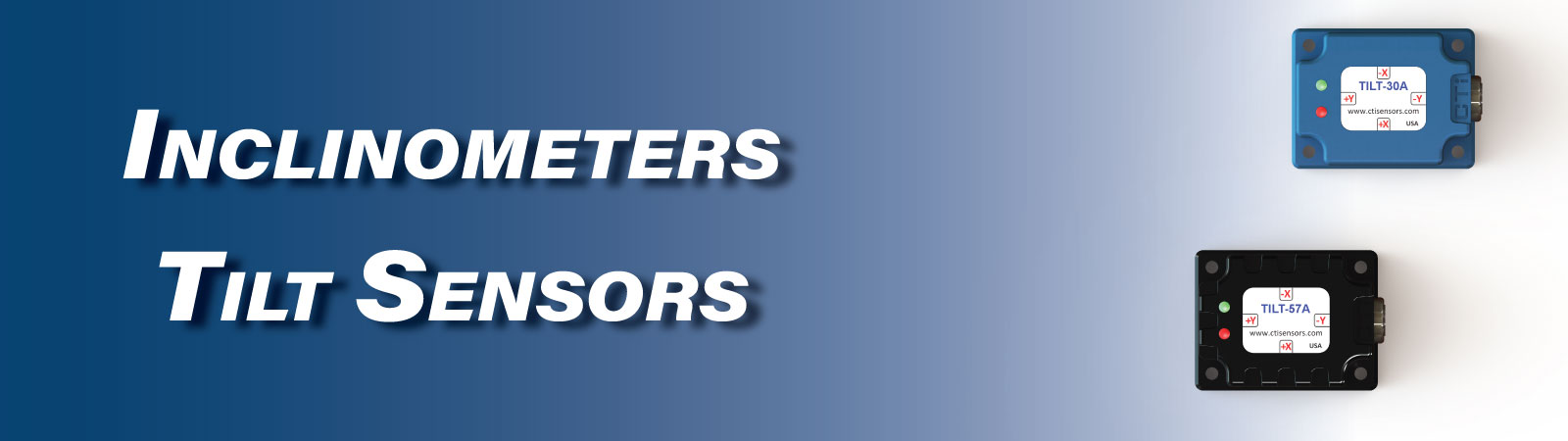
Static VS Dynamic Inclinometers
Choosing the right tilt sensor is critical for the long-term reliability and accuracy of any industrial or navigational system. The decision of which tilt sensor is right for your application depends on one fundamental question: Is your system primarily static, or is it subject to movement, shock, or vibration? The answer determines whether you need a Static Inclinometer or a Dynamic Inclinometer.
This guide is designed to clarify the core differences between these two technologies, explain how each operates, and help you select the ideal CTi Sensor series—from our ultra-stable TILT-3x static sensors to our advanced TILT-5x dynamic motion tracking solutions—to perfectly match your application’s operational environment.
Static Inclinometers: Stability Through Gravity
A Static Inclinometer is engineered for environments where the sensor platform is either at rest or moving so slowly that external forces like acceleration and vibration are negligible. The core measurement principle relies entirely on gravity as a reference point.
The Static Principle: Pure Accelerometer Data
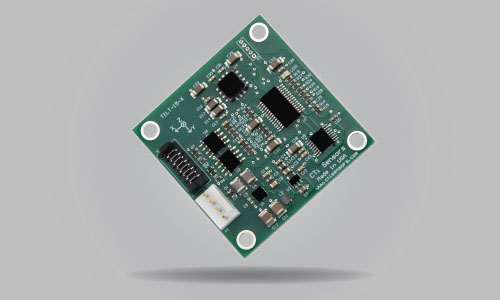
Our static inclinometers, such as the TILT-05, TILT-15, and TILT-3x series, use high-precision accelerometers to measure the direction and magnitude of the Earth’s gravitational field. When the sensor tilts, the accelerometer’s output changes, and this change is directly converted into a pitch and roll angle.
The result is exceptional stability and high accuracy when stationary. This makes static sensors perfect for applications that require:
- Fixed Alignment: Leveling tools, antenna alignment, structural monitoring.
- Stationary Monitoring: Monitoring the tilt of a fixed structure or foundation.
- Low-Cost Integration: Simple systems where budget and size are the primary constraints
Our Static Series Highlights:
- TILT-05 Series: Our low-cost, low-power OEM solution for simple tilt measurement. It uses pure accelerometer data to provide high stability and accuracy in a miniature 1″ x 1″ footprint. Perfect for embedded systems where cost and space are critical constraints.
- TILT-15 Series: Provides an advanced, high-accuracy option (down to 0.05° typical accuracy in the TILT-15-X) with the critical feature of simultaneous analog and digital outputs. This versatility makes it ideal for precision industrial weighing systems, such as forklift weighing and crane load monitoring, where high stability and dual-interface compatibility are required.
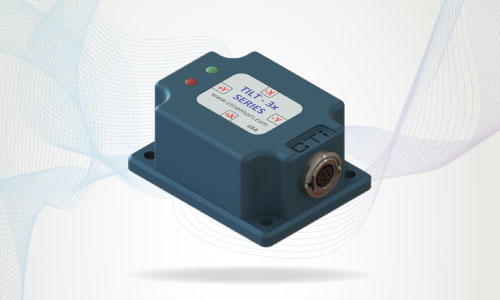
- TILT-3x Series: Our ultimate high-precision static solution. By focusing on ultra-low noise, high resolution, and temperature stability, the TILT-3x delivers superior long-term accuracy and features a rugged, IP67-rated aluminum enclosure for demanding industrial use, such as precision platform alignment.
The Critical Challenge: Linear Acceleration Noise
The limitation of all static inclinometers becomes apparent the moment the platform begins to move. In a dynamic environment, the sensor is exposed to linear acceleration noise—the forces generated by starting, stopping, turning, or experiencing vibration.
Because the static sensor cannot differentiate between the force of gravity (true tilt) and the force of movement (noise), it mistakes lateral movement for an actual change in the pitch or roll angle. The sensor output will become momentarily, or even completely, inaccurate, rendering it useless for dynamic control systems.
If your application involves any significant movement—from a crane slewing its boom to a vehicle driving over rough terrain—the stable, high-resolution performance of even a top-tier static sensor like the TILT-3x will be severely degraded.
Watch the Comparison: Static vs. Dynamic In Motion
The most effective way to understand this difference is to see it in action. The video below provides a side-by-side demonstration that shows how a static sensor’s output is overwhelmed by noise, while the TILT-5x maintains a clean, accurate tilt angle throughout the movement.
Watch the video to confidently decide whether the high-stability of our Static TILT-05, TILT-15, and TILT-3x Series is suitable for your low-dynamic needs, or if you require the noise-rejecting intelligence of our TILT-5x Dynamic Inclinometers.
Dynamic Inclinometers: The Solution to Motion
When reliable, real-time angle measurement in motion is essential, you must utilize a Dynamic Inclinometer from the TILT-5x Series.
The Dynamic Principle: Sensor Fusion and Gyroscopes
The TILT-5x Series (TILT-50, TILT-55, TILT-57) overcomes the limitations of static sensors by incorporating a sophisticated, two-pronged approach:
- Gyroscopes (Angular Rate Sensors): A 3-axis gyroscope measures the rate of rotation independent of gravity or acceleration in three axes.
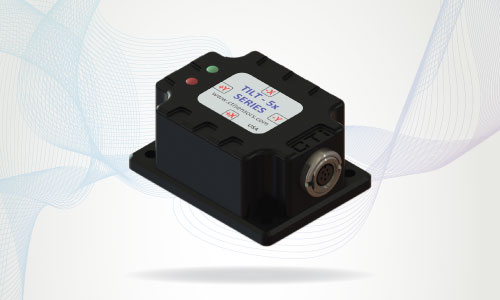
- Sensor Fusion (Kalman Filtering): This is the “secret.” The dynamic sensor’s internal processor combines the stable, long-term accuracy of the accelerometer with the precise, high-speed angular rate data from the gyroscope. A complex fusion algorithm mathematically analyzes both data streams to isolate and reject external linear acceleration noise.
This allows the TILT-5x to provide a clean, true pitch and roll angle output even while your machinery (such as construction vehicles, marine vessels, or robotics) is actively moving, making it the only viable choice for dynamic control loops.